Monday, February 28, 2011

Why Didn't I Think of That?!

image via
 Friends, my life has changed for the better! Above is a standard palette, probably laying flat on a table next to an easel. I've been painting with this set-up for as long as I can remember. The problem is that this causes a delay between mixing a color and applying it to the canvas.

via 


Enter the vertical palette! Why have I not thought of this before?! I read an article about David Kassan who uses an arrangement in his studio similar to the one in the picture to the right. (I wish I could find a picture of his actual palette to share.) Anyway, he has a glass insert set onto a backing toned the same color as his painting surface, and propped on an easel beside his work. Brilliant!

As soon as I reach a good stopping point with a few of the projects that I'm working on, I'm going to make a vertical palette of my own!

Monday Match

via

Mary Cassatt "The Coiffure"

Monday Match: Urban Green Edition

Wayne Thiebaud
via: miss moss

Friday, February 25, 2011

Happy (Productive) Weekend!

Friends, I don't know about you, but this has been one crazy busy month for me! I'm usually itching to run head-long into Spring, but this year the prospect of March coming in like a lion seems a lot more probable that it going out like a lamb.

My weekends are going to look a lot more like my weeks for the foreseeable future. On the upside though, I have some really exciting projects lined up for the next few months, and as Thomas Jefferson said "A mind always employed is always happy.  This is the true secret, the grand recipe, for felicity."

Thursday, February 24, 2011

Little Fish in a Big Pond

http://little-people.blogspot.com/

I love these little people. Imagine going about your day and stumbling upon one of them! They remind me that we are all little fish in a big pond.

Wednesday, February 23, 2011

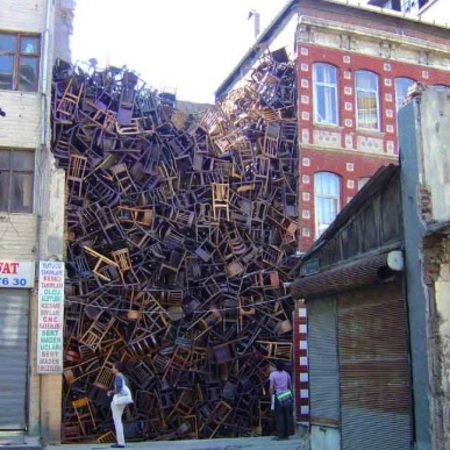
Abandoned Lot or Prime Real Estate?

Sometimes it is what is between the "important" information in a work of art that really packs a punch!


Sculpture Doris Salcedo stacks over 1,550 chairs between two buildings via
This concept spans across artistic forms. I just learned about Derek Attridge's idea of "unrealized/virtual beats" in poetry. To say it simply, these are rests in a four beat line. They act like actual beats even though they are really silences between words.

I had almost forgotten (rest)
That words were made for rhyme: (rest)
And yet how well I knew it -- (rest)
Once upon a time! (rest)

(This example is of a Christopher Morley's poem from The Anthologist)

via
One of the most spectacular examples of this idea in dance is STOMP. Have you seen it? You should. It's kind of indescribable, but basically involves choreographed percussion, extreme movement and everyday objects. Its basis is beat, but its pauses make those beats all the more powerful.

John Singer Sargent


One of the first lessons a visual artist learns involves the concept of negative space or the "blank" areas between the subject of an artwork and the image edge. It takes a surprising amount of skill and courage to concentrate as much on these spaces as on the subject itself, but doing so can energize an otherwise simple artwork. Sargent chose to turn the potential "abandoned lot" of the background in this painting into "prime real estate."  By fusing the darkness of the background with the negative shapes of the shadows on the figure, he creates the essential drama of this piece. The "empty" areas are at least as crucial as the detailed sections.

Tuesday, February 22, 2011

Still Waters Run Deep

I love when a work of art invites closer inspection of its working components. Here are some of my favorite examples of art that is more than what it seems:

Posterity- The Holy Place Damien Hirst
Hirst used butterfly wings and high-gloss house paint to create the above reflection on life and death.

Real Life is Rubbish Tim Noble and Sue Webster
Nobel and Webster piled and lit ordinary objects to reveal these shadow silhouettes projected from the original "rubbish" stacks.

Fanny/Fingerpainting 1985 Chuck Close
Chuck Close used his inked finger prints to create this enormous piece. I remember being fascinated by it as a little girl visiting the National Gallery. My admiration for Close only increased after visiting his exhibit at the Corcoran this fall. His quote at that show sums up his process for me:  

"As a kid I loved magic, but I used to break the cardinal rule of the magician. After I did the magic trick, I would go back and show everyone how I did (it)...It's supposed to ruin the experience but I found it didn't. You could show them how you did it and they would still be amazed."

I think that these seemingly straight-forward works mirror the intricacy of the human person in a unique way through the surprising articulation of their material parts. 


Related Posts Plugin for WordPress, Blogger...